
Gallery Info
SMART-PEDs: Systemic Multi-scale Approaches for Rapid Transition to Positive Energy Districts
Start date: 01/12/2025
End date: 30/11/2028
Budget: 1.478.526 €
Funding programme:
European Union’s Horizon Europe research and innovation programme under the CET Partnership co-funded call. CDTI, Spanish Government.

Description
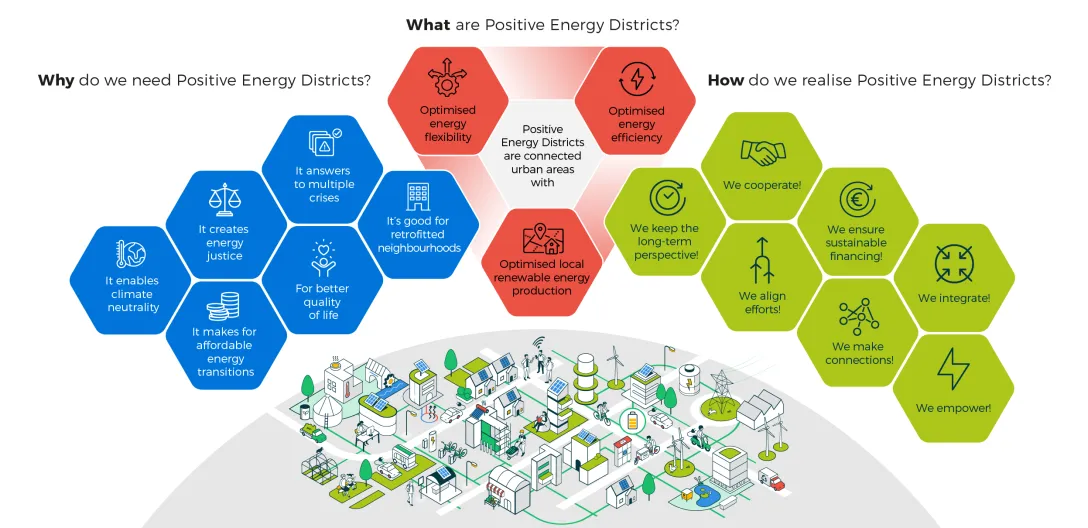
The main challenge addressed by SMART-PEDs is the fragmented and isolated implementation of Positive Energy Districts (PEDs), which slows down Europe’s climate transition and misses crucial systemic synergies. Current planning tools are often overly technical, disconnected from broader city strategies, and overlook the essential social dimension of the energy transition.
SMART-PEDs specifically aim to bridge this gap by exploring how PEDs can be integrated systemically across multiple scales (building, district, and city) while explicitly embedding principles of energy justice. The project examines how to develop tools and governance models that not only enhance technical performance and economic viability, but also ensure that the benefits of PEDs (such as reduced energy costs and improved comfort) are equitably distributed, particularly among vulnerable households at risk of energy poverty.
To address these challenges, SMART-PEDs develops a systemic framework along with an open-source, multi-scale decision-support toolbox. This toolbox enables users to simulate PED scenarios, assess techno-economic feasibility, evaluate socio-economic and energy justice impacts, and navigate complex regulatory environments.
The work is grounded in a transdisciplinary, co-creation approach implemented across four diverse urban Living Labs: Lyngby-Taarbæk (Denmark), Lund (Sweden), Winterthur (Switzerland), and Fuengirola (Spain). In these real-world environments, collaboration takes place with municipal planners, energy providers, SMEs, and community representatives to test, validate, and refine both the framework and the toolbox. This approach ensures that the solutions are practical, user-oriented, and adaptable to a wide range of climatic, social, and regulatory conditions, directly supporting evidence-based and equitable urban planning.
CEMOSA's Role
CEMOSA co-designs, develops, and implements a set of innovative, interactive decision-support tools tailored to the strategic integration of Positive Energy Districts (PEDs) across multiple urban scales.
It is responsible for leading prototype validation and iterative testing processes, the deployment of prototypes, and the documentation of open-source digital tools. CEMOSA also oversees the application of the digital tool in the Fuengirola pilot case and contributes to the development of an integrated framework for assessing the technical, economic, and social viability of PEDs, taking into account regulatory factors and energy justice considerations.
In addition, CEMOSA contributes to other project activities by supporting the analysis of national and European policies, assisting in the assessment of social and environmental impacts in the Fuengirola pilot case, contributing to the definition of the architecture and design of the interactive tool, and validating results through participatory workshops and socio-economic and environmental impact analyses.
Otros proyectos