


Gallery Info
PREMAKER: Predictive Models for Large-Scale Robotic Additive Manufacturing of Recycled Materials

Start date: 01/11/2025
End date: 30/06/2028
Budget: 2.329.599 €
Funding programme:
This project has received funding from the Centre for the Development of Technology and Innovation (CDTI), co-financed by the European Regional Development Fund (ERDF) 2021–2027, through the INNTERCONECTA-STEP Regional Consortia funding programme.

Description
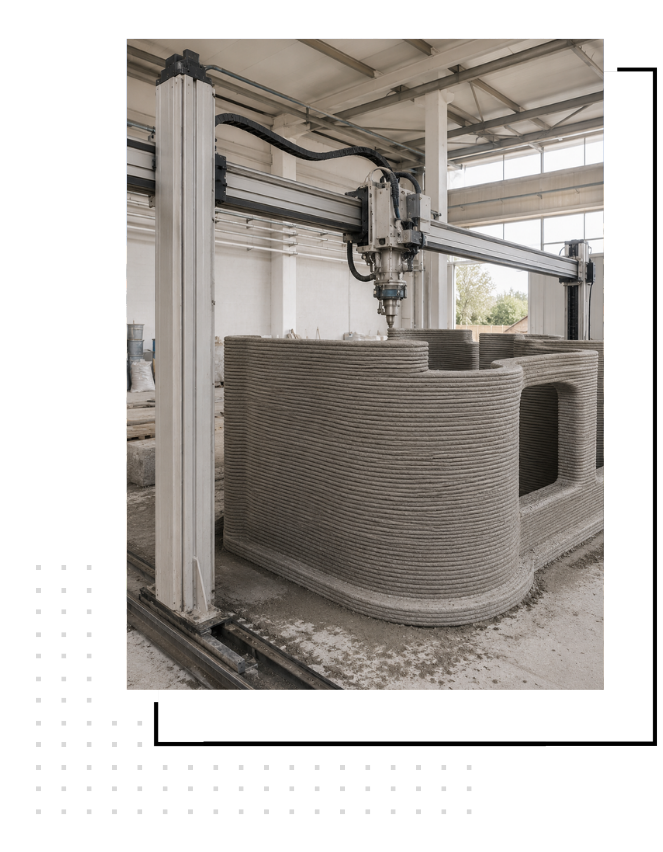
PREMAKER is an R&D project aimed at advancing large-format robotic additive manufacturing (LFAM) through the combination of advanced recycled materials, artificial intelligence, computer vision and structural simulation. The aim is to overcome the current limitations of large-scale 3D printing, particularly issues relating to warping, shrinkage, inter-layer adhesion and the lack of suitable materials for construction applications.
- Development of new sustainable composite materials from recycled plastics sourced from sectors such as the electrical-electronic and automotive industries (rPP, rPC, rABS and rPET).
- Research into materials with advanced structural properties, fire resistance and UV resistance for applications in architecture and construction.
- Optimisation of the LFAM 3D printing process through the integration of infrared (IR) heating systems to improve inter-layer bonding and reduce manufacturing defects.
- Development of machine vision, thermographic imaging and artificial intelligence systems capable of detecting defects in real time and predicting failures before they occur.
- Manufacture and validation of full-scale 3D-printed architectural and construction prototypes.
- Expected reduction of at least 30 per cent in the carbon footprint compared with equivalent solutions manufactured using traditional processes.
CEMOSA's Role
CEMOSA is the partner responsible for ensuring that the solutions developed can be used safely and effectively in real-world construction applications. Its role focuses on structural engineering, simulation, geometric optimisation and the digitalisation of quality control.
- It leads the definition of technical requirements, use cases and structural specifications that will form the basis for all other activities.
- Carries out structural simulations using finite element methods to determine which geometries and materials are suitable for each architectural application.
- Analyses the relationship between material, printing process and mechanical behaviour to ensure that the parts can withstand the loads and stresses required by building regulations.
- Uses BIM methodologies and digital tools to design, validate and optimise 3D-printed building components.
- Develops quality control systems based on advanced image processing to detect defects, cracks or anomalies in the manufactured parts.
- Participates in the development of automated inspection and quality control procedures applicable both in the factory and on site.
- Validates the final prototypes from a structural and construction perspective prior to their potential implementation in real-world applications.
Otros proyectos